Blackjack Strategy: The Basic Strategy Chart, Explained Line by Line
Published · Updated · 10 min read · By the PlayersReports Editorial Team
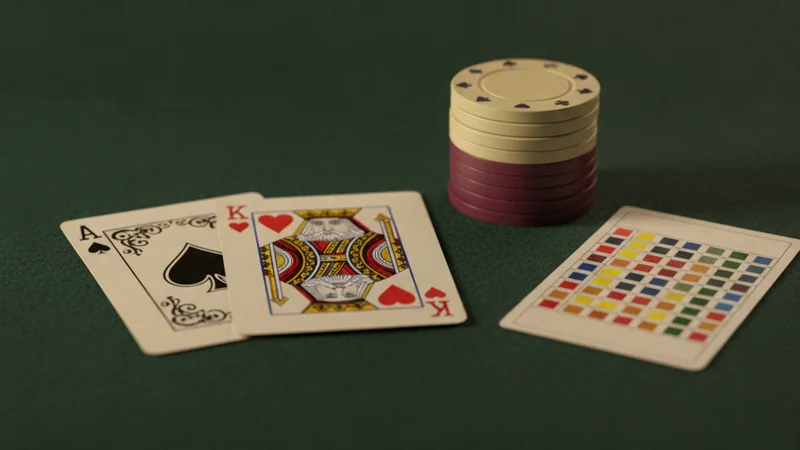
Blackjack strategy, in the sense most players mean it, is a single chart: for every hand you can hold and every card the dealer can show, it tells you the play that loses least over the long run. It is not a betting system and it is not card counting. It was worked out mathematically seventy years ago, every serious analysis since has confirmed it, and it fits on a card small enough to keep beside you at an online table. This guide gives the full chart for the most common online and live-dealer rules, then explains each part of it, so that the decisions make sense instead of feeling like rules to memorise.
If you are new to the game itself, read our guide on how to play blackjack first. It covers the card values, the order of play and what hitting, standing, doubling and splitting mean. Everything below assumes you know those basics.
Where Basic Strategy Comes From
In September 1956, four mathematicians serving at the US Army’s Aberdeen Proving Ground, Roger Baldwin, Wilbert Cantey, Herbert Maisel and James McDermott, published the first accurate blackjack strategy in the Journal of the American Statistical Association. They did it with desk calculators. A few years later Edward Thorp borrowed their notebooks and checked the work on an IBM 704 computer at MIT, before going on to show in Beat the Dealer (1962) that card counting could shift the odds. Basic strategy is the part of that work that needs no counting: it assumes you know only your own cards and the dealer’s upcard.
The strategy has been refined since, mainly for different rules and numbers of decks, but its shape has hardly changed. The chart below comes from Wizard of Odds, one of the most widely cited blackjack analyses, and we checked every cell against its published chart and text strategy for the same rules.
The Rules This Chart Assumes
Basic strategy depends on the rules, so here are the ones this chart is built for. They match most standard online and live-dealer blackjack tables:
- Four to eight decks. The strategy is the same across that range.
- The dealer stands on all 17s (S17), including soft 17.
- You can double on any first two cards.
- You can double after splitting (DAS).
- No surrender. The changes if surrender is offered are covered further down.
- Blackjack pays 3 to 2, and the dealer checks for blackjack before you act.
If your table has different rules, the chart still gets almost every decision right. The few exact changes for the most common variations are listed below the tables.
The Basic Strategy Chart
Find your hand in the left column and the dealer’s upcard along the top. Use the pairs table first if you hold a pair; otherwise use the soft table if your hand contains an ace counted as 11, and the hard table for everything else.
Legend: H = hit. S = stand. D = double if allowed, otherwise hit. Ds = double if allowed, otherwise stand. P = split.
Hard totals
| Your hand | 2 | 3 | 4 | 5 | 6 | 7 | 8 | 9 | 10 | A |
|---|---|---|---|---|---|---|---|---|---|---|
| 5–8 | H | H | H | H | H | H | H | H | H | H |
| 9 | H | D | D | D | D | H | H | H | H | H |
| 10 | D | D | D | D | D | D | D | D | H | H |
| 11 | D | D | D | D | D | D | D | D | D | H |
| 12 | H | H | S | S | S | H | H | H | H | H |
| 13 | S | S | S | S | S | H | H | H | H | H |
| 14 | S | S | S | S | S | H | H | H | H | H |
| 15 | S | S | S | S | S | H | H | H | H | H |
| 16 | S | S | S | S | S | H | H | H | H | H |
| 17+ | S | S | S | S | S | S | S | S | S | S |
Soft totals
| Your hand | 2 | 3 | 4 | 5 | 6 | 7 | 8 | 9 | 10 | A |
|---|---|---|---|---|---|---|---|---|---|---|
| A,2 (soft 13) | H | H | H | D | D | H | H | H | H | H |
| A,3 (soft 14) | H | H | H | D | D | H | H | H | H | H |
| A,4 (soft 15) | H | H | D | D | D | H | H | H | H | H |
| A,5 (soft 16) | H | H | D | D | D | H | H | H | H | H |
| A,6 (soft 17) | H | D | D | D | D | H | H | H | H | H |
| A,7 (soft 18) | S | Ds | Ds | Ds | Ds | S | S | H | H | H |
| A,8 and A,9 | S | S | S | S | S | S | S | S | S | S |
Pairs
| Your hand | 2 | 3 | 4 | 5 | 6 | 7 | 8 | 9 | 10 | A |
|---|---|---|---|---|---|---|---|---|---|---|
| 2,2 | P | P | P | P | P | P | H | H | H | H |
| 3,3 | P | P | P | P | P | P | H | H | H | H |
| 4,4 | H | H | H | P | P | H | H | H | H | H |
| 5,5 | D | D | D | D | D | D | D | D | H | H |
| 6,6 | P | P | P | P | P | H | H | H | H | H |
| 7,7 | P | P | P | P | P | P | H | H | H | H |
| 8,8 | P | P | P | P | P | P | P | P | P | P |
| 9,9 | P | P | P | P | P | S | P | P | S | S |
| 10,10 | S | S | S | S | S | S | S | S | S | S |
| A,A | P | P | P | P | P | P | P | P | P | P |
A pair of 5s is never split; it is played as a hard 10. The splits for 2s, 3s, 4s and 6s against low cards assume you may double after splitting. Without that rule, hit 2,2 and 3,3 against a 2 or 3, hit 4,4 against everything, and hit 6,6 against a 2.
The Logic Behind the Chart, Region by Region
Two facts explain most of the chart. First, the dealer has no choices: they must keep drawing until they reach 17 or more. Second, the dealer’s upcard tells you a lot about where their hand is likely to end up. A 2 to 6 leaves the dealer most likely to need several cards, and so most likely to bust. A 7 to ace means the dealer is likely to finish on a strong total. Almost every decision below follows from those two points.
Hard 17 and above: stand
Any card worth 5 or more busts a hard 17, and the chance of improving it is small. Standing loses to a dealer who reaches 18 or better, but hitting loses more often. That is why the bottom row of the hard table is all S.
Hard 13 to 16 against a 2 to 6: stand; against 7 to ace: hit
These are the hands that feel worst, and the logic is about the dealer, not you. Against a weak upcard the dealer must draw and often busts, so you leave the risk with them and stand. Against a 7 or higher the dealer will usually finish on 17 or more, so standing on 13 to 16 means you will usually lose. Hitting risks busting, but it is the only way to reach a hand that can win. Against strong upcards these are losing hands either way, and hitting simply loses less often.
Hard 12: hit against a 2 or 3, stand against 4 to 6
This is the part of the chart that surprises people most. With 12, only a ten-value card busts you, and that is about four cards in thirteen. A dealer showing a 2 or a 3 busts less often than a dealer showing 4, 5 or 6, so against those two cards the extra chance of improving your 12 is worth the bust risk. Against a 4 to 6 the dealer’s bust chance is high enough that you stand and let them take the risk. The difference is small, which is why some casual charts get this line wrong, but it is real.
Hard 9, 10 and 11: double when the dealer is weak
Doubling means doubling your stake for exactly one more card, so you want to do it when one card is likely to give you a strong hand and the dealer is likely to finish weak or bust. With 11, any ten-value card makes 21, and many other cards make 18 to 20. That is why 11 doubles against everything except an ace under these rules. With 10 the chance is slightly lower, so you stop doubling against a dealer 10 or ace, which are most likely to make 19 or 20 themselves. With 9 the advantage is narrower still, so you double only against 3 to 6.
Soft hands: the ace gives you a free hit
A soft hand cannot bust on the next card, because the ace drops from 11 to 1 if needed. That makes soft 13 to 17 hands ideal for doubling against a weak dealer. The extra card can only help, and the dealer is the one likely to bust. Against a 7 or higher you simply hit, because your soft total is not strong enough to stand on.
Soft 18 (A,7) is the soft hand most players misplay. It looks like a good total, but against a 9, 10 or ace it usually loses. Hitting it can’t bust you, so you hit. Against a 2, 7 or 8 you stand; against 3 to 6 you double if allowed and otherwise stand.
Pairs: split to escape a bad hand or to press an advantage
Always split aces. Two aces count as 2 or 12, a poor start. Split, and each ace begins a hand that can make 21 with any ten-value card.
Always split 8s. A pair of 8s is 16, the worst total in the game. Two hands starting from 8 are much better, even against a dealer 10 or ace, where splitting doesn’t so much win as lose less than standing on 16 would.
Never split 10s. A pair of tens is 20, which beats most dealer hands. Splitting replaces a hand that wins most of the time with two hands that start from 10 and often finish lower. It costs money against every upcard.
Never split 5s. A pair of 5s is 10, one of the best doubling hands there is. Splitting it creates two hands starting from 5, which are poor. Play it as a hard 10.
Split 9s, except against a 7, 10 or ace. Eighteen is solid but beatable. Against a dealer 7, 18 is already likely to beat the dealer’s most common result of 17, so you stand. Against a 10 or ace your 18 is unlikely to win, but splitting into two hands starting from 9 is even worse, so you stand and accept the probable loss.
Split 2s, 3s, 6s and 7s against low cards; split 4s only against a 5 or 6. These splits turn a weak total into two hands, each with a better chance against a dealer likely to bust. With double after split allowed, these splits are worth more, because a split 2 or 3 that draws an 8 or 9 can then be doubled.
Insurance: never
When the dealer shows an ace you will usually be offered insurance: a side bet of up to half your stake that the dealer’s hidden card is a ten, paid at 2 to 1. It sounds like protection, but it is a separate bet, and a poor one. In an eight-deck shoe, once the dealer’s ace is showing, 128 of the remaining 415 cards are tens. The bet wins 2 units 128 times and loses 1 unit 287 times, an average loss of 31 units in every 415, or about 7.5% of what you stake. With six decks the figure is about 7.4%. “Even money” on your own blackjack against a dealer ace is the same bet under a different name. Basic strategy declines both.
What Changes With Other Rules
When the dealer hits soft 17 (H17)
Many tables, especially live dealer games, have the dealer hit soft 17. That is worse for you: Wizard of Odds puts the cost at 0.22 percentage points against the S17 game. The strategy changes in only three places without surrender:
- Double 11 against an ace.
- Double soft 18 (A,7) against a 2 (Ds: double if allowed, otherwise stand).
- Double soft 19 (A,8) against a 6 (Ds).
When late surrender is offered
Late surrender lets you give up half your stake after the dealer checks for blackjack. Under S17 rules, surrender:
- hard 16 against a 9, 10 or ace, but not a pair of 8s, which you still split;
- hard 15 against a 10.
On an H17 table also surrender hard 15 against an ace, 8,8 against an ace and hard 17 against an ace. Wizard of Odds values late surrender against a ten at about 0.07 percentage points to the player under its baseline rules.
How Much Basic Strategy Changes the House Edge
With the rules this chart assumes, a blackjack game played perfectly to basic strategy has a house edge commonly cited at around half a per cent. That is one of the lowest in the casino, as our guide to the lowest house edge casino games shows. The rules then move it noticeably. Using Wizard of Odds’ figures, measured against an eight-deck S17 game with doubling after splitting:
| Rule change | Effect on the player |
|---|---|
| Dealer hits soft 17 | −0.22 percentage points |
| No doubling after splitting | −0.14 points |
| Blackjack pays 6 to 5 instead of 3 to 2 | −1.39 points |
| Six decks instead of eight | +0.02 points |
| Single deck | +0.48 points |
| Late surrender against a ten | +0.07 points |
The 6 to 5 row matters most. A single payout change costs nearly three times the entire house edge of a well-ruled game, and no strategy can win it back. Check the blackjack payout before you check anything else on a table.
Equally important is what basic strategy cannot do. It does not remove the house edge, and it does not change the variance. You will still have losing streaks, sometimes long ones, and the expected result is still a small loss for every hand you play. Its value is that it makes your blackjack as cheap as the rules allow. Players who play by feel commonly give back several times the half-per-cent edge through errors such as standing on soft 18 against a 10, taking insurance or splitting 10s.
Using the Chart at an Online Table
The chart works best when you use it, not when you try to recall it from memory. Online blackjack lets you keep it open beside the game, and nothing stops you taking your time over each decision. A few practical points:
- Match the chart to the table. Check the game’s rules or help panel for deck count, soft 17, doubling after split, surrender and the blackjack payout. If the table hits soft 17, apply the three H17 changes above.
- Ignore side bets. Perfect Pairs, 21+3 and similar side bets carry their own, much larger house edges and are not part of basic strategy.
- Remember bonus terms. Many casino bonuses count blackjack at a small fraction towards wagering, or exclude it, and some list systematic or “low-risk” play as a breach. Read the terms before you play blackjack with bonus money.
- Set limits first. Decide your session budget before you sit down and stop when it is gone. Our responsible gambling page lists free, confidential support if blackjack, or any gambling, stops feeling like entertainment.
Basic strategy is the one part of blackjack that is entirely in your control. It won’t make you a winner, but it makes sure the only edge at the table is the one written into the rules.
Sources and further reading
Regulators, standards bodies and primary references behind this guide.
- → Wizard of Odds — 4-deck to 8-deck blackjack strategy (chart and text strategy, dealer stands on soft 17)
- → Wizard of Odds — Effect of blackjack rule variations on the player's return
- → Wikipedia — Four Horsemen of the Apocalypse (blackjack): Baldwin, Cantey, Maisel and McDermott, Journal of the American Statistical Association, September 1956
- → UC Irvine Libraries — Edward O. Thorp exhibit: A Winning Hand
Frequently Asked Questions
What is blackjack basic strategy?
Basic strategy is the mathematically best way to play each hand you can be dealt, given your two cards and the dealer's upcard, for a particular set of table rules. It was first worked out by four US Army mathematicians and published in 1956. It tells you when to hit, stand, double or split. It does not use card counting and it does not give you an edge; it makes the casino's edge as small as the rules allow.
Does basic strategy mean I will win at blackjack?
No. Basic strategy minimises the house edge, typically to around half a per cent on a good six- or eight-deck game, but the edge stays with the casino. You will still lose some sessions badly and win others. Over enough hands the expected result is a small loss per hand played, not a profit, which is why it only makes sense as a way to make your entertainment cost less.
Should I take insurance in blackjack?
Not as a basic strategy player. Insurance is a side bet that the dealer's hidden card is a ten-value card, paid at 2 to 1. In an eight-deck shoe with an ace showing, 128 of the remaining 415 cards are tens, so the bet loses about 7.5% of what you stake on average. With six decks it is about 7.4%. That is many times worse than the main game.
What changes if the dealer hits soft 17?
On an H17 table the dealer draws to soft 17 instead of standing, which is worse for you: Wizard of Odds puts the cost at 0.22 percentage points. The strategy changes in only a few places: double 11 against an ace, double soft 18 against a 2, double soft 19 against a 6, and, where surrender is offered, also surrender 15, a pair of 8s and 17 against an ace.
Why should you always split 8s and never split 10s?
Sixteen is the worst hand in blackjack, so splitting 8s turns one poor hand into two hands that each start from 8, a far better starting point even against a dealer ten. A pair of 10s is already 20, which wins most of the time; splitting it gives up a strong hand for two weaker ones, which loses money on average against every dealer upcard.