How to Play Blackjack: Rules, Table Choices and the One Strategy That Matters
Published · Updated · 9 min read · By the PlayersReports Editorial Team
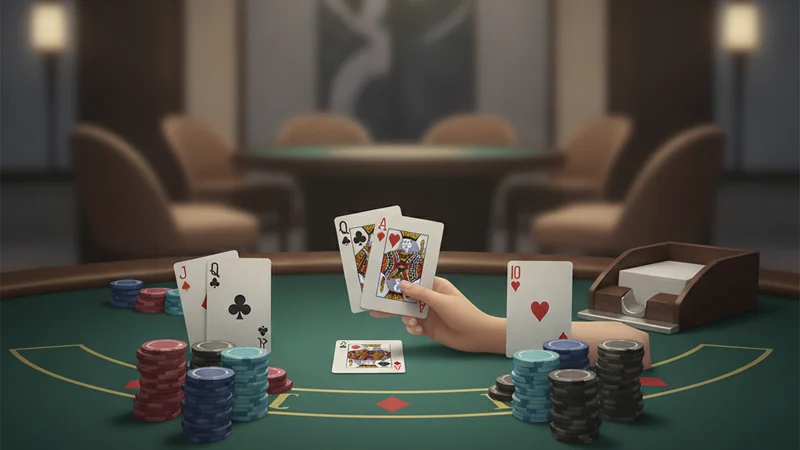
Blackjack is a card game in which you play against the dealer, not the other players, and try to finish with a hand closer to 21 than the dealer’s without going over. It is quick to learn: you need the card values, five decisions and the dealer’s fixed rules. This guide explains each of those in order, then covers the part most beginner guides skip, which is how the rules printed on the table change what the game costs you. It ends with the one thing that genuinely lowers that cost, basic strategy, and the honest limit of what it can do.
The game rules below follow New Jersey’s published blackjack regulations, which set out the standard game clearly, and the house edge figures come from the Wizard of Odds rule-variation tables. Online and in other countries, tables vary, so we also show you what to check before you sit down.
The Aim of the Game
Each round, you are dealt two cards and the dealer is dealt two. You win if your final total beats the dealer’s without exceeding 21, or if the dealer goes over 21 (“busts”) while you have not. If you go over 21, you lose straight away, even if the dealer later busts too. That one rule is where the casino’s edge comes from: you always act first, so your busts are settled before the dealer has to take any risk.
If you and the dealer finish on the same total, the hand is a tie, usually called a push, and your stake is returned.
Card Values
The card values are simple and are written into New Jersey’s rules word for word:
- Cards from 2 to 10 count at their face value.
- A jack, queen or king counts as 10.
- An ace counts as 11, unless that would take the hand over 21, in which case it counts as 1.
A hand that contains an ace counted as 11 is called a soft hand, because it cannot bust on the next card: if a high card comes, the ace simply drops to 1. A-6, for example, is “soft 17”. A hand with no ace, or with an ace that has to count as 1, is a hard hand. 10-7 is “hard 17”.
A blackjack, or natural, is an ace plus any ten-value card as your first two cards. It beats every other 21 and is paid at a special rate, which is where the 3:2 and 6:5 question comes in.
How a Round Is Dealt
- You bet. Place your stake in the betting box before any cards are dealt.
- The deal. Each player gets two cards, usually face up in a casino shoe game. The dealer gets one card face up and one face down (the hole card), or in some games one card now and the second later.
- Check for blackjack. If the dealer’s up-card is an ace, insurance is offered (see below). Where the rules allow, the dealer checks for blackjack before anyone plays.
- You play your hand. Starting from the dealer’s left, each player makes decisions until they stand or bust.
- The dealer plays. The dealer turns over the hole card and draws to fixed rules, with no choices.
- Settlement. Wins are paid, losses collected, pushes returned.
Your Five Decisions
Hit
Take another card. You can keep hitting until you stand or go over 21.
Stand
Take no more cards and keep your total.
Double down
Double your stake and receive exactly one more card. New Jersey’s rule states that the extra wager may not exceed the original and that “one and only one additional card shall be dealt” to the hand. Doubling is how you make the most of strong positions, such as 11 against a weak dealer card. Some tables restrict doubling to totals of 10 or 11 only, or 9 to 11, and that restriction costs you a little, as we show below.
Split
If your first two cards are the same value, you can split them into two hands, putting a second stake equal to the first on the new hand. Each hand then gets a second card and is played separately. Split aces are the usual exception: in New Jersey they receive one card each and no more. A 21 made after splitting is normally paid as an ordinary 21, not as blackjack. Tables vary in how many times you can resplit and whether you may double after a split.
Surrender
Where it is offered, you can give up your hand after seeing your first two cards and get half your stake back. New Jersey’s rules require the decision to be made before you hit, stand, double or split. If the dealer then turns out to have blackjack, the whole stake is lost, which is why this version is known as “late surrender”. Surrender is for a small number of very poor hands, such as hard 16 against a dealer ten. Many online and live tables don’t offer it at all.
Insurance and Even Money
When the dealer shows an ace, you are offered insurance: a side bet of up to half your original stake that the hole card is a ten-value card. New Jersey’s rules set the maximum at half the original wager and pay winning insurance at 2 to 1.
Paying 2 to 1 implies a one-in-three, or 33.3%, chance of winning. In a full shoe, 16 of every 52 cards are tens or picture cards, about 30.8%. The price on offer is shorter than the true chance, so the bet loses over time. If you want to see how odds turn into a percentage, our implied probability calculator does the conversion for any price. When you hold a blackjack yourself, the dealer may offer even money instead, paying your blackjack at 1:1 straight away. Mathematically, that is the same insurance bet in a different form, and basic strategy declines both.
How the Dealer Plays
The dealer has no choices. In New Jersey, casinos choose one of two options, and the table must follow it:
- Stand on all 17s (S17). The dealer stands on any total of 17 or more, including soft 17.
- Hit soft 17 (H17). The dealer stands on hard 17 and on soft 18 or more, but draws on soft 17.
The rule is normally printed on the felt, for example “Dealer must stand on all 17s” or “Dealer hits soft 17”. It matters: Wizard of Odds puts the cost of the dealer hitting soft 17 at 0.22 percentage points of house edge, compared with standing.
Why the Table Rules Change What You Pay
Two blackjack tables can look identical and cost very different amounts to play, because small rule changes move the house edge. Wizard of Odds measures each change against an eight-deck game where the dealer stands on soft 17. These are its published figures for the player’s side, where a minus sign means the rule costs you:
| Rule | Effect on the player |
|---|---|
| Blackjack pays 6:5 instead of 3:2 | −1.39% |
| Dealer hits soft 17 | −0.22% |
| Double on 10 or 11 only | −0.18% |
| No doubling after a split | −0.14% |
| No resplitting | −0.10% |
| Late surrender against a ten | +0.07% |
| Resplitting aces allowed | +0.08% |
| Six decks instead of eight | +0.02% |
| Single deck | +0.48% |
The first line is the one that matters most. On a 6:5 table, a 10-unit blackjack pays 12 instead of 15. That one change costs more than every other unfavourable rule on the list combined. It is common on low-limit casino tables and on some online games, and it is the single best reason to walk away from a table.
A five-point table checklist
Before you play any blackjack table, live or online, check:
- Blackjack pays 3:2. Avoid 6:5 entirely.
- Dealer stands on soft 17. S17 beats H17.
- Double on any first two cards, and double after split allowed.
- Surrender offered. It’s a small plus when it is.
- Side bets ignored. Side bets carry their own, usually much higher, house edge. Our guide to the casino games with the lowest house edge compares them with the main game.
Blackjack Online: RNG Games and Live Dealers
Online casinos offer two kinds of blackjack, and they behave differently:
- RNG blackjack uses a random number generator to deal from a virtual shoe. In practice the cards are shuffled for every hand, and you play alone and at your own pace. The rules and payout should be shown in the game’s help screen. Read them, because 6:5 and H17 versions exist alongside 3:2 games.
- Live dealer blackjack is streamed from a studio with real cards and a human dealer. It feels like a casino, but it is slower, and many studios use continuous shuffling or shuffle well before the end of the shoe.
Why Card Counting Doesn’t Work Online
Card counting works in principle only when cards are dealt from a shoe that runs down over many hands, so a player can track how many high cards are left. Online, that rarely happens. RNG games effectively start each hand from a fresh deck, so there is nothing to track. Live tables that use continuous shuffling machines return cards to the shuffle constantly. As Arnold Snyder put it for the Las Vegas Advisor, continuous shufflers “have no effect on basic strategy, only on card counting”, because “you never have a chance for the count to go up (or down)”.
So the only skill that reliably changes your results online is the same one that works in a land-based casino: playing each hand correctly.
Basic Strategy: The Only Strategy That Moves the Edge
Basic strategy is the mathematically best decision for every combination of your hand and the dealer’s up-card, worked out by computer simulation for each set of table rules. It tells you when to hit, stand, double, split or surrender. It isn’t a betting system and doesn’t depend on previous hands. It simply avoids the costly mistakes most players make, such as standing on 12 against a dealer 7, never doubling, or splitting tens.
A few lines show the logic:
- Always split aces and eights.
- Never split tens or fives.
- Double 11 against every dealer card except an ace, under many common rule sets.
- Stand on hard 17 or more. Hit hard 12 to 16 when the dealer shows 7 or higher.
- Never take insurance.
The full chart, explained line by line, is in our blackjack strategy guide.
The honest limit is this: basic strategy reduces the house edge, but it never removes it. With good rules, a basic strategy player faces one of the lowest edges in the casino. The dealer’s advantage of acting last still means the casino comes out ahead over time. Changing your stake after wins or losses, using progressive “systems” or following hunches doesn’t change that. Those approaches only change how quickly and how unevenly you win or lose.
Playing Sensibly
Blackjack is fast, especially online, where an RNG table can deal hundreds of hands an hour. A low house edge applied to a lot of hands is still a cost. Decide your budget and session length before you start, treat that budget as the price of the entertainment, and stop when it’s spent. If you notice yourself chasing losses or playing longer than you meant to, the free, confidential support options on our responsible gambling page are a good next step. Gambling is for adults only, and online casino play is restricted or illegal in many places, so check the law where you live before you play.
Sources and further reading
Regulators, standards bodies and primary references behind this guide.
- → New Jersey Administrative Code § 13:69F-2.2 — Blackjack: cards, number of decks and value of cards
- → New Jersey Administrative Code § 13:69F-2.9 — Blackjack: insurance wagers
- → New Jersey Administrative Code § 13:69F-2.10 — Blackjack: doubling down
- → New Jersey Administrative Code § 13:69F-2.12 — Blackjack: drawing of additional cards by players and the dealer
- → Wizard of Odds — Blackjack rule variations and their effect on the house edge
- → Las Vegas Advisor — Question of the Day, 1 February 2017 (continuous shuffling machines and card counting)
Frequently Asked Questions
How do you play blackjack for beginners?
You and the dealer each get two cards, and you try to finish closer to 21 than the dealer without going over. Number cards count at face value, picture cards count 10 and an ace counts 11 or 1. You choose to hit, stand, double, split or sometimes surrender, then the dealer plays to fixed rules and the best total wins.
What is the difference between a 3:2 and a 6:5 blackjack table?
It is what a natural blackjack pays. At 3:2 a 10-unit bet wins 15; at 6:5 it wins only 12. Wizard of Odds puts the cost of a 6:5 payout at 1.39 percentage points of house edge, more than any other common rule change, so a 6:5 table is the single worst rule you can accept.
Should you ever take insurance in blackjack?
Not as a basic strategy player. Insurance pays 2 to 1, which implies a one-in-three chance that the dealer's hidden card is a ten. With a full shoe only 16 of every 52 cards are ten-value, about 30.8 per cent, so over time the bet loses. Even money on your own blackjack is the same insurance bet under another name.
Does basic strategy guarantee you will beat the dealer?
No. Basic strategy is the mathematically best way to play each hand, and it cuts the house edge to its lowest level for the table's rules, but the edge stays with the casino. You will still lose more sessions than you win in the long run. Its value is that it stops you giving away extra money through poor decisions.
Can you count cards at online blackjack?
Not usefully at RNG games, which reshuffle a virtual deck for every hand, or at live tables using continuous shuffling. As Arnold Snyder explains for the Las Vegas Advisor, a continuous shuffler means the count never builds up, so counting has nothing to work with. Basic strategy still applies and works exactly as well.